






 Tienes reportajes guardados

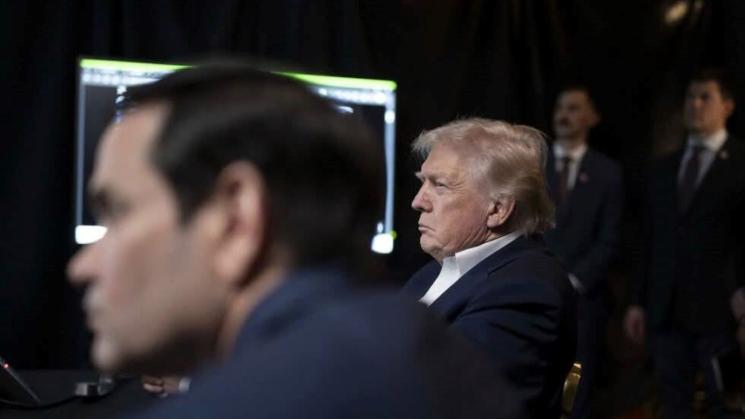
CONTRADICTION. On January 2nd, Nicolás Maduro was captured, but Donald Trump left part of the top leadership of his regime intact.


In Jan. 2, 2026, the U.S. military snatched Venezuelan ruler Maduro and his wife, Cilia Flores, from the presidential palace in Caracas and whisked them to the United States to stand trial for drug trafficking. President Trump declared the operation part of law enforcement efforts to stem the flow of drugs to the United States, before pivoting to the real reason for the military action–gaining U.S. access to Venezuelan oil fields.
Trump’s decision to leave in place the Maduro regime’s chief criminal leadership, many of them also indicted in U.S. courts for drug trafficking, was a clear indication that the removal of Maduro was driven by oil economics rather than a move toward a democratic transition and restoration of the rule of law.
Just a month before, Trump issued an unprecedented pardon of former Honduran president Juan Orlando Hernández, convicted of trafficking 400 tons of cocaine to the United States. The juxtaposition of these two cases sharply defines how Trump’s deeply transactional approach to foreign policy and subordination of economic interests to the rule of law, is empowering organized crime groups and terrorists in Latin America, rather than combating them.
The juxtaposition of these two cases starkly sharply defines how Trump’s deeply transactional approach to foreign policy".
The evidence in the Hernández case was overwhelming, and Hernández was sentenced to 45 years in prison. The irony, not lost on those of us who investigated the case for many years, is that many of the cocaine shipments that Hernández and his brother Tony – also convicted and imprisoned–brokered for the Sinaloa cartel, originated in Venezuela. Their network operated with the complicity of military officers who are loosely allied in what is commonly called the Cartel de los Soles, although it is really more of a criminal holding company.
Despite the evidence presented by U.S. law enforcement and prosecutors, Hernández was freed due to the financial and political influence of his friends in Trump’s inner circle, and the leadership of the Cartel de los Soles remains largely intact.
The influence of MAGA
Other damaging actions by the Trump administration include: the lifting of financial sanctions on former Paraguayan president Horacio Cartes, who in January 2023 was publicly identified by the U.S. Treasury Department as a collaborator of designated terrorist group Hezbollah ; the efforts to repatriate leaders of the MS-13 gang, to El Salvador, reportedly to protect Trump ally Nayib Bukele from the embarrassment of their testimony on a secret pact with Bukele spilling out in trial.
Trump’s friendship with Bukele is problematic in other ways that seem to fly in the face of his stated support for the rule of law. For example, at the center of Bukele’s inner financial circle is José Luis Merino, publicly identified by then Sen. Marco Rubio and multiple law enforcement reports as a major security threat to the United States for being the primary weapons provider to the FARC guerrillas and important money launderer for the Venezuela regime and FARC guerrillas, designated a terrorist organization for more than two decades.
Trump’s friendship with Bukele is problematic in other ways that that seem to fly in the face of his stated support for the rule of law".
By Trump’s own designations, the groups named above–the Sinaloa Cartel, Cartel de los Soles, Hezbollah, the MS-13 gang and FARC dissident guerrilla– are all terrorist and criminal groups, yet each has benefited from the Trump administration’s actions.
Cumulatively, these decisions have empowered criminal and terrorist organizations across the hemisphere that the Trump administration claims to be combating as a national security priority. These actions have undone decades of work by U.S. and allied law enforcement and intelligence agencies that brought solid cases against those important individuals and organizations that pose direct strategic threats to U.S. interests and cause direct harm to the United States.
At the center of the successful efforts that have led to the pardoning and freedom of convicted criminals and publicly identified terrorist enablers is a cadre of MAGA-aligned lobbyists and influencers whose profoundly anti-democratic, pro authoritarian agenda is reshaping the region. This network reaches Trump directly or makes their cases through Trump family members and acolytes while relying on Tucker Carlson and other MAGA media to create narratives of shared grievances and “lawfare” against Trump allies.
This network and its messaging are often closely aligned with the neo-fascist Putin ideologue Alexander Dugin, a guest on Carlson’s show multiple times, who is the intellectual architect of the Russia First justification for invading Ukraine, and, before that, of Crimea. This network also has deep ties to far right former Brazilian president Jair Bolsonaro, another Trump favorite, and Argentina’s extreme right.
In the case of the pardon of Hernández, disgraced former Nixon dirty trickster Roger Stone, disgraced former congressman Matt Gaetz and a cadre of MAGA evangelical pastors were important actors.
Hernández’s pardon came two days after Trump’s overtly interventionist support on social media for Nasry Asfura, political heir to Hernández’s National Party, whose party machine set the standard in Latin America for corrupt political operations. Asfura’s primary election adviser is Fernando Cerimedo, an Argentine political operative who Brazilian authorities found to be at the heart of the massive disinformation campaigns waged by Bolsonaro and his efforts to overthrow his country’s 2022 election results in ways that mirrored the Jan. 6 attacks in Washington.
Pardon for Hernández and Cartes
Bukele finds refuge for his own false narratives with Carlson and, through his lobbyist Damian Merlo, has enlisted Gaetz, Donald Trump Jr, and a host of other MAGA heavy hitters to defend the Salvadoran president’s massive human rights violations, political persecution, and gang relationships.
In each case, Trump bought into a shared sense of victimhood with the MAGA-aligned leaders and blamed the Biden administration for waging lawfare against them for political reasons. In each case, this is a lie. In fact, in each case the sanctions and investigations were initially led by Trump appointees.
- Emil Bove: Once Trump’s personal lawyer and now a federal judge, led the investigation into Hernández and his brother, resulting in their convictions.
- The Treasury and intelligence community investigations into the ties of former Paraguayan president Cartes to Hezbollah and major organized crime were largely carried out in Trump’s first administration.
- Task Force Vulcan: The special interagency group that documented Bukele’s corrupt ties to the MS-13 and went to extraordinary lengths to capture MS-13 leaders freed from prison by Bukele, was created by then Attorney General Bill Barr, Trump’s appointee.
The harm caused by Trump’s direct empowerment of criminal and terrorist organizations in the hemisphere far outweighs the strategic impact of removing Maduro but leaving the regime intact and blowing up small launches in the Caribbean that, if carrying cocaine are at best moving a few kilos, are having to deter drug trafficking. The almost farcical double standard of Trump’s applications of military force and pardons simultaneously is directly empowering criminal and terrorist organizations in ways that are mind bending for their cynicism, hypocrisy, and incongruity.
In each case Trump bought into a shared sense of victimhood with the MAGA-aligned leaders".
While the Hernández pardon received U.S. media attention, the full scope of the corrupt machine he presided over for years is important to underscore. One of the most shocking events of his tenure was the November 2019 murder of a key witness against Hernández, Nery Orlando López, who had kept the ledgers of narco payments to the Hernández brothers.
Once the existence of the ledgers became public in Tony’s 2018 trial, MS-13 gang members held in prison with López were paid to execute him, an event that was filmed on prison security cameras and that I reviewed at the time. The gang members drag him from his cell, calmly pull pistols out of their waistbands and begin shooting him. As he lay bleeding on the floor, they pull out machetes and begin hacking him to death. Then they unhurriedly put their weapons away and walk out, with no fear of being apprehended by the police or prison guards. The only possible beneficiaries of the brazen assassination were the Hernández brothers, although Lopez's ledgers were ultimately used to convict both of them.
The October 25, 2025, Treasury Department order lifting the visa and financial sanctions on Cartes was almost as important as the Hernández pardon but went relatively unnoticed despite the 2023 finding that Cartes not only obstructed major international criminal investigations, but had “documented involvement with foreign terrorist organizations” and “has ties to members of Hezbollah.”
Cartes’s involvement with Hezbollah and Iran was the most visible indicator of a massive illicit cigarette smuggling empire that spans Latin America and the Caribbean. His use of Iranian/Venezuelan aircraft to move tons of cigarettes were cited as part of the sanctions package, but his deep involvement in multiple illicit markets as both before and after his time as Paraguay’s president (2013-2018) were well documented.
Interests with Bukele
In El Salvador, Trump’s efforts to exchange access to illegally warehouse ICE deportees in Bukele’s CECOT mega prison in return for dropping the cases against MS-13 gang leaders in the United States have been amply documented. In return for shielding Bukele and his inner circle from having gang leaders testify to the corrupt and lucrative deal they clandestinely cut with the Salvadoran president– extremely damaging for a leader who has built his global reputation on the false narrative of militarily defeating the gang– Trump was able to offload his legally and politically troublesome problem of holding migrants without charges on U.S. territory.
Less known but also well documented is that one of Bukele’s chief financial backers is José Luis Merino, a former Communist Party urban commando in El Salvador’s civil war (1980-1991) whose post-war career centered on brokering massive shipments of weapons to Colombia’s FARC guerrillas that were targeting U.S. forces, and laundering billions of dollars for the Maduro regime and the Cartel de los Soles.
In a 2016 Senate hearing, then Sen. Rubio stated that Merino “is a top-notch, world class money launderer, arms smuggler for the FARC as well as corrupt Venezuelan officials. How is this guy not sanctioned?” In June 2017, a bipartisan group of 14 Congressmen formally requested that the Treasury Department investigate Merino because he was believed to have “acquired hundreds of millions of dollars in unexplained wealth while helping the FARC guerrillas in Colombia, corrupt elements of the Venezuelan government, and other criminal groups move funds to safe harbor.”
Merino was a major funder of Bukele’s 2019 and 2024 presidential campaigns, and just before Bukele took office, Merino was formally accused by the attorney general of El Salvador of laundering USD 3.2 billion in corrupt funds–an investigation Bukele closed almost immediately. Since Secretary of State Rubio met with Bukele to seal the prison deal, Merino has not been mentioned.
The floodgates of transactional, strategically damaging dismantling of the rule of law by exonerating criminal leaders, drug traffickers, and enablers of terrorist is hidden behind a veneer of moral posturing to justify incoherent policies and unjustified killings. The magnitude of the hypocrisy and strategic incoherence is stunning. For the United States to again be viewed as a reliable partner against transnational organized crime and terrorism in the Western Hemisphere, now at the center of Trump’s National Security Strategy, it must not enable the very enemies it claims to fight.