


Update: September 30, 2025 - 03:05 p.m.
Halfway along the road between Santa María de Nieva, in the province of Condorcanqui, and Bagua, in the department of Amazonas, a narrow path opens up through the dense vegetation. After a five-minute walk, out of sight of passing cars, there is a small wooden house with graffiti that tells the story of the new wave of violence in this part of the Amazon. On one of its walls, it says: "Be careful, don't enter this house. Don't get into trouble." A few steps further along the same path, coca leaf crops cover the nearby hillsides.
The plantations are located just 200 meters from one of the roads connecting Condorcanqui, on the border with Ecuador, to the Peruvian coast. This route, called PE-5NC, takes almost five hours to travel and covers about 56 kilometers.
Unlike the other, more modern and faster highway, this road has little traffic. Organized crime takes advantage of the region’s remoteness. A team from OjoPúblico traveled the area, interviewed prosecutors and police officers, indigenous leaders, and accessed confidential information showing how, after the pandemic, in addition to the expansion of illegal mining, the province of Condorcanqui has become one of the new hubs of drug trafficking in the Peruvian Amazon.

CORRIDOR. Most of the coca crops in the department of Amazonas are concentrated along the PE-5NC highway, which connects the province of Condorcanqui with the Peruvian coast.
Photo: OjoPúblico / Renato Pajuelo.
The annual report of the National Commission for Development and Life without Drugs (Devida) confirms the advance of illegal coca leaf cultivation in this department: 95% of the cultivation areas monitored in Amazonas—equivalent to 1,264 hectares—are concentrated in the district of Nieva.
Nieva accounts for almost half (44%) of the entire population of the province of Condorcanqui (the other districts are El Cenepa and Río Santiago). Of the approximately 42,000 inhabitants of the province, a large majority—82%—are indigenous, mainly Awajún and Wampis.
A bastion of drug trafficking
While in the Apurímac, Ene, and Mantaro River Valley (Vraem)—where 40% of Peru's coca crop area is still concentrated—the size of plantations decreased in 2024 for the first time in three years (-5%), the opposite occurred in Amazonas: the area almost tripled. It went from 656 hectares in 2020 to 1,818 hectares in 2024, an increase of more than 277%, according to Devida data.
"The entire area between Santa María de Nieva and Bagua is controlled by drug traffickers. The police who enter [this area] cannot intervene: the drug traffickers take their weapons away and even burned one of our trucks. Lately, it is becoming a second Vraem," a police officer from the Peruvian Anti-Drug police (Dirandro) who has participated in local interventions told this media outlet.
The officer is referring to an operation in January 2022, when a group of alleged drug traffickers attacked police officers and recovered drugs that had been seized from them in the town of Monterrico. This settlement, located alongside the PE-5NC highway, is currently the stronghold of coca production in the area, according to authorities. The police only enter the area by helicopter.
Unlike the Awajún communities that live along the highway, Monterrico is a town where migrants from other parts of Peru reside. Some of them arrived during the coronavirus pandemic, others after the war between Peru and Ecuador. The Awajún call them colonos.
Monterrico's housing also distinguishes it from the indigenous communities. In the town center, there is a hotel, a guesthouse, and several three- and four-story houses built with cement and bricks, while most indigenous homes are made of wood.
According to police sources and local residents, settlers have bought or rented land from indigenous families in recent years to grow coca. One neighbor says they offer landowners around S/ 2,000 per hectare per year. During the harvest, which takes place up to four times a year, workers receive S/ 1.50 per kilo of leaves.
"Families openly admit that they grow [coca] because there is no economic support or state presence here. When I ask them why they do it, they reply: because of the same necessity that forces us to work; because we have to educate our children and we have to feed ourselves in this way to survive," says an Awajún leader in the area.

Map: OjoPúblico / Jhafet Pianchachi.
Police target Colombian leader
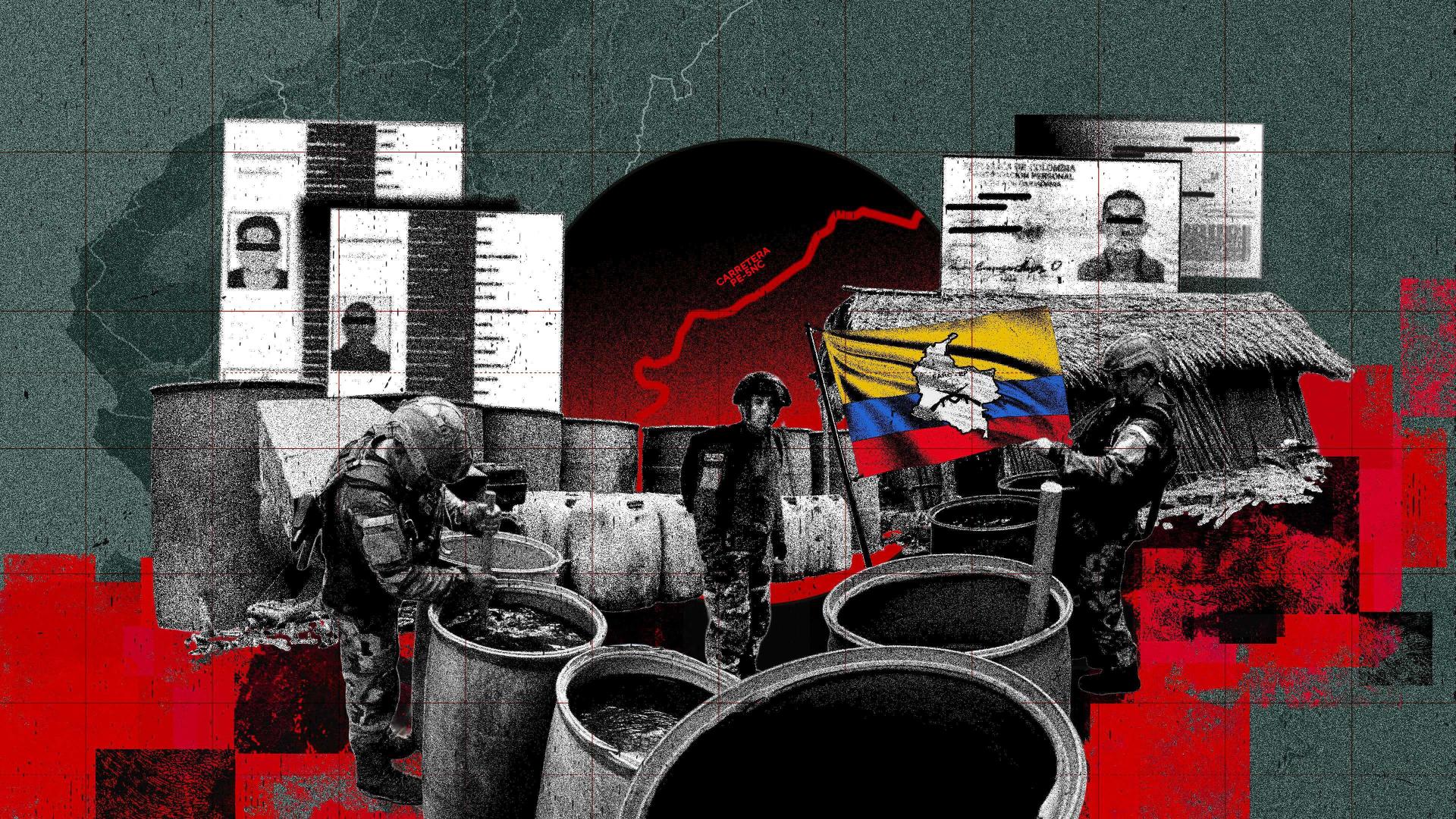
On the morning of October 28, 2022, Dirandro units land by helicopter on the outskirts of the village of Monterrico. Their objective: to capture drug traffickers in a house that, according to police intelligence, served as a collection center and laboratory for the production of cocaine base paste.
According to a confidential report accessed by OjoPúblico, around 80 people—including women and children from neighboring communities—wait for the helicopter at the landing site. The crowd carries sticks and stones. The men hold containers of gasoline and threaten to attack the agents and set them on fire.
During the operation, several people flee and hide in the forest. At the collection center, agents find 10.7 kilograms of cocaine base paste, various chemicals used in its production, and several personal documents, including the ID cards of a woman and a man of Colombian nationality.
Authorities identified the man as 42-year-old Julio Erminson Hoyos Ortiz. According to a confidential report from October 2023, he is a "member or coordinator of the violent Colombian group FARC-EP."
The FARC officially disarmed following a 2016 peace agreement with the Colombian government. Dissidents—fighters who refused to demobilize—operate in parts of Colombia and border areas of Ecuador, Venezuela, and Peru, engaging in drug trafficking, extortion, and armed control.
According to the police report, Hoyos Ortiz directs deforestation activities in protected areas, distributes coca seeds, sets up laboratories, builds clandestine airstrips, and pays local residents for their collaboration.
His influence is not limited to Monterrico, the documents state. It also extends to communities and population centers such as San José de Línea, Japaime-Quebrada, Nuevo Siasme, Imaginaria, Quebrada de Kamita Entsa, Sawintsa, and Tunduza, all in Condorcanqui.
Both Hoyos Ortiz and the Colombian woman, whose identity card was found during the operation in Monterrico, are currently facing criminal proceedings for the crime of illicit drug trafficking in Peru, with international legal assistance from Colombia. Police sources consulted by OjoPúblico indicate that Hoyos Ortiz is still involved in cocaine production in Condorcanqui.
Police documents from the October 2022 operation reveal seven additional profiles: three community members accused of acting with particular violence against the agents and four settlers linked to drug trafficking. Among them, one name stands out and is frequently repeated in Nieva: Merino.
He is identified as the voice of the coca growers in meetings with indigenous organizations and local authorities. His real identity, however, does not appear in police records.
Seizures skyrocket
The rise of trafficking in Amazonas is also reflected in seizures of cocaine base paste and cocaine hydrochloride. In this region, between 2015 and 2021, the police seized almost half a ton of cocaine base paste and cocaine hydrochloride; while in the last four years alone—up to July of this year—the figure shot up to 9.2 tons, according to data accessed by this media outlet.
In 2023 and 2024 alone, the police seized 3.5 and 3.1 tons of drugs, respectively. In addition, between 2022 and 2024—the last operation took place in December 2023—the police detected four laboratories dedicated to drug production in the district of Nieva.

LABORATORY. The province of Condorcanqui is not only a center for coca cultivation, it has also become a center for cocaine production.
Photo: Peruvian National Police.
According to prosecutor Luz Mery Zuzunaga Silva, who worked between 2022 and August 2025 in the Amazonas Provincial Prosecutor's Office Specializing in Illegal Drug Trafficking, local drug traffickers use the so-called "Colombian method."
In this process, also known as the "alkaline method" or "tank method," the leaves are not dried for a long period of time; instead, the active ingredients are extracted using alkalis and other chemicals poured into small tanks. Among the supplies found during the raids were a petroleum derivative, acetone, and cement.
In addition to the presence of FARC dissidents, prosecutor Zuzunaga Silva warns that traffickers from Bolivia, Ecuador, and Brazil also come to Condorcanqui to buy the processed drugs. "Due to its development and strategic location—with clandestine airstrips, in a border area, and little control—the situation is increasingly worrying," she says.
The prosecutor laments that Anti-Drug police Dirandro does not have a base in Condorcanqui. In previous operations, it was necessary to deploy units from San Martín, Huánuco, and Piura.
By river, air, and land: the three drug routes
In two operations carried out in July 2022 and December 2023 in the district of Nieva, Dirandro destroyed three clandestine airstrips used to transport cocaine in light aircraft with stopovers in Colombia, Brazil, and Bolivia. According to local residents and police sources, at least one of them resumed operations after the interventions.
In addition to the air route, there are two other drug routes from Condorcanqui. The same sources indicate that most of the drugs are transported by land, hidden in trucks carrying bananas, pineapples, wood, or in vans bound for Bagua.

CONTROL. Dirandro agents inspect the pineapple cargo of a truck en route from Santa María de Nieva to Bagua.
Photo: OjoPúblico / Renato Pajuelo.
The third route follows the Santiago River and crosses the border with Ecuador. Although the boat trip takes at least a day, this route remains active due to the strategic importance of the port of Guayaquil in Ecuador for shipping cocaine to Europe and the United States, according to this year's report on drug trafficking in Peru by the NGO Amazonwatch.
The influence of criminal organizations from Ecuador is also growing in Condorcanqui. Awajún leaders and residents of El Cenepa denounce the presence of the Ecuadorian criminal organization Los Choneros and the involvement of the Los Trujillanos gang, originally from La Libertad, in armed clashes between illegal miners within their territory.
In the triple border area between Peru, Ecuador, and Colombia, the Comandos de la Frontera (Border Commandos)—one of the FARC dissident groups—have formed alliances with Los Choneros—one of the largest and most violent criminal organizations in Ecuador—to transport cocaine from the border to ports on the Ecuadorian coast, as revealed by an former investigation of OjoPúblico.
Cautious resistance
The boom in coca leaf production in Nieva—which, according to Devida, accounts for 95% of Condorcanqui's crops—coincides with increased deforestation in the region. An analysis of Global Forest Watch data indicates that between 2001 and 2024, the district of Nieva lost 53,192 hectares of forest.
The trend has accelerated alarmingly in the last seven years: since 2018, 29,205 hectares have been lost, representing 55% of the total area deforested in the last two decades.

INVASION. Nieva's forest area has shrunk between 2001 and 2024, especially along roads and rivers.
Graph: Amazon Conversation Team / Global Forest Watch.
The loss of forests in their territory is one of the main reasons why indigenous leaders in the area reject the expansion of coca cultivation. In 2022, according to a document accessed by OjoPúblico, six Awajún and Wampís organizations, together with the municipality of Condorcanqui, several community leaders, and the Chachapoyas Anti-Drug Prosecutor's Office, agreed at a meeting to take joint action against drug trafficking.
"But people had already gotten used to earning their daily bread with drugs," says an Awajún leader who lives along the PE-5NC highway. He explains that both he and Devida have tried to convince community members to switch to cocoa. However, the price of this crop is unstable and only allows for two harvests per year, while coca can be harvested up to four times in twelve months, he points out.
Awajún leaders reported that in August 2024, a new meeting was held to combat drug trafficking. Once again, an agreement was reached, but this time only among the apus of the Awajún indigenous communities of the Shawit Indigenous Federation (FISH). The others did not join in.
The Shawit organization encompasses four indigenous communities with 36 annexes in the southern part of the PE-5NC highway, a four-hour drive by truck from Bagua. The mutual commitment of the apus was that from that moment on, they would no longer rent or sell land for coca cultivation.
However, this federation is only one of eleven indigenous organizations—including the Autonomous Territorial Government of the Wampis Nation (GTANW) and the Awajún Autonomous Territorial Government (GTAA)—in the province of Condorcanqui.
"Since 1990, indigenous organizations here have been divided into basins due to differing positions on the entry of oil and mining companies. This decentralization helps drug traffickers negotiate access to new land," says an Awajún leader.
Links to illegal mining
At the same time that cocaine production was growing in Condorcanqui, the territory of the Awajún and Wampís peoples—particularly the Cenepa and Santiago river basins—also became a hotspot for illegal mining, as several OjoPúblico reports have exposed.
The high price of gold makes illegal mining attractive, as well as a mechanism for laundering drug trafficking proceeds. "We have evidence that the people behind illegal mining are linked to drug trafficking, because they seek total control of Condorcanqui," warns prosecutor Luz Mery Zuzunaga.
According to police sources, suppliers of mining equipment benefit from the simultaneous expansion of drug trafficking and illegal mining. The "Colombian method" of cocaine production requires fuel, which also powers the engines of dragas (floating platforms that pump sediment from the riverbed to the surface).
Both illicit activities depend on large volumes of chemicals. Miners use toxic mercury to separate gold, while cocaine laboratories use alkalis and acids. "If a transporter is responsible for moving acid along with acetone, they can also offer cyanide or even mercury in their sales portfolio," says an agent of Peruvian Anti-Drug police.
Conservative crop measurement
In its latest report, Devida lists the department of Amazonas as the region with the highest proportional increase in coca cultivation in the country—44% between 2023 and 2024. For years, the province of Condorcanqui remained off the radar.
In 2021, Devida added the area to its monitoring system for the first time, following a Dirandro report that identified clandestine airstrips in Condorcanqui in 2020. Since then, the border province with Ecuador is no longer a blind spot.

LOGGING. The forests of Condorcanqui are suffering from the expansion of drug trafficking in Amazonas.
Photo: OjoPúblico / Fidel Carrillo.
However, the actual scale of cultivation could exceed the official figures. Analysts who participated in the preparation of the report acknowledged to OjoPúblico that the registration system—in which Devida cooperates with the United Nations Office on Drugs and Crime (UNODC)—needs improvement.
For example, Devida only counts areas "in production." In other words, a crop must be at least one year old to be included in the report. If the agency detects a field, it is incorporated into the statistics when it is re-registered a year later.
Recent plantations—such as those documented by an OjoPúblico team in August along the road between Santa María de Nieva and Bagua—can begin producing harvestable leaves within four to six months. Nonetheless, they are not included in the official statistics, which reduces the accuracy of the registry in the face of rapid increases in cultivation.
